
The Residence Hall License Contract ("Contract") is a binding legal agreement between the student ("Student") and Appalachian State University ("University") for a term of one academic year. The Contract sets out the terms and conditions to which the student must adhere. Additionally, the Contract grants the Student permission to use a residence hall space and, and once an assignment is possible, guarantees a space (subject to reassignment) on the campus of Appalachian State University campus.
Physical Well-Being in the Residence Halls
University Housing works to maintain residence halls that are safe, clean, and comfortable for students. Creating a healthy living environment is a shared responsibility between residents and housing staff. The information below outlines how we support physical well-being in the residence halls, and how residents can help maintain their living spaces.
Health and Safety Checks
Health and safety checks are conducted at least once each semester and before break periods. These checks help ensure that residence hall rooms remain safe and in good condition.
During these checks, two University Housing staff members will enter each room or unit to look for potential facility concerns and policy violations. Staff will also verify that sprinklers and smoke detectors are not blocked, and review the condition of University Housing furniture. Residents will receive advance notice before checks take place. Students do not need to be present during the inspection. If any concerns are identified, residents will receive follow-up communication and will have the opportunity to correct the issue for re-inspection.
If the concern is not addressed, University Housing may take steps to resolve it, and any related costs may be billed to the resident.
Preventative Maintenance
Maintaining a healthy living environment is a priority for University Housing. Regular preventative maintenance helps reduce facility issues and keeps residence halls operating safely.
Examples of preventative maintenance include:
- Scheduled air filter changes
- Furniture and mattress replacement cycles
- Deep cleaning during break periods and the summer
- Routine assessments of plumbing, electrical, HVAC, and emergency systems.
Residents are encouraged to report any facility concerns through the Maintenance Request system. When air quality concerns are reported, staff will assess the space and measure temperature, humidity, and dew point using specialized equipment. Housing staff members who live and work in the halls are also available to help students understand how to maintain a healthy shared living environment.
Allergens
Because of the outdoor environment in Boone and the surrounding mountains, pollen and other allergens can sometimes affect students living on campus. This may affect students with allergies as well as those who have not previously experienced symptoms. Students who experience allergy symptoms should consider contacting their healthcare provider or scheduling an appointment with M.S. Shook Student Health Services. Students can also take steps to reduce allergens in their rooms. Health experts often recommend the following practices:
- Wash sheets, pillowcases, and blankets weekly in hot water (at least 130 F/54 C)
- Use dust-mite-proof covers for pillows, mattresses, and box springs
- Replace wool or feather bedding with synthetic materials
- Avoid placing backpacks or clothing work outside on the bed
- Shower or wash hair before going to bed during high pollen periods
- Use washable area rugs with low pile and vacuum weekly with a HEPA-filter vacuum
- Use washable curtains made from cotton or synthetic fibers
- Keep windows closed during high pollen seasons when possible
- Reduce items that collect dust such as decorative items, books, and magazines
- Clean surfaces with a damp cloth and vacuum or damp-mop floors regularly.
Air Quality
Maintaining good air quality in residence halls requires participation from everyone in the community. Molds exist in all environments and generally do not pose a concern for most healthy individuals. However, keeping living spaces clean and dry can help maintain good indoor air quality.
Residents can support a healthy environment by:
- Keeping rooms organized and limiting clutter
- Dusting and cleaning surfaces regularly
- Washing bedding frequently
- Drying wet clothes or towels promptly
- Removing or cleaning tapestries that collect dust
- Taking out trash regularly
- Storing food in sealed containers and disposing of produce properly
- Checking plant soil for mold and repotting or discarding plants if mold appears
- Limiting strong-scented products such as air fresheners
- Opening windows briefly when weather allows to circulate fresh air
- Vacuuming carpets and rugs and sweeping or mopping regularly.
If a resident notices a facility concern, they should submit a Maintenance Request so staff can investigate.
Air Quality Checklist
Download the Air Quality Checklist PDF (345.14 KB)
Your health and safety are important to us! Here is a checklist of common issues that impact air quality.
Please Complete This Checklist on a Regular Basis
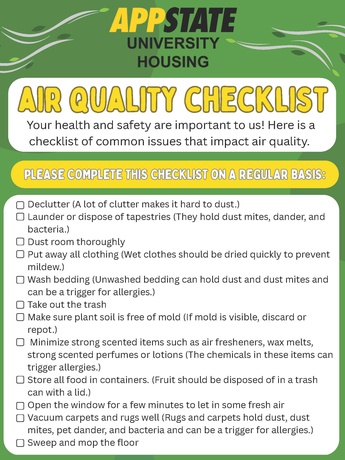
☐ Declutter (A lot of clutter makes it hard to dust.)
☐ Launder or dispose of tapestries (They hold dust mites, dander, and bacteria.)
☐ Dust room thoroughly
☐ Put away all clothing (Wet clothes should be dried quickly to prevent mildew.)
☐ Wash bedding (Unwashed bedding can hold dust and dust mites and can be a trigger for allergies.)
☐ Take out the trash
☐ Make sure plant soil is free of mold (If mold is visible, discard or repot.)
☐ Minimize strong-scented items such as air fresheners, wax melts, strong-scented perfumes or lotions (The chemicals in these items can trigger allergies.)
☐ Store all food in containers. (Fruit should be disposed of in a trash can with a lid.)
☐ Open the window for a few minutes to let in some fresh air
☐ Vacuum carpets and rugs well (Rugs and carpets hold dust, dust mites, pet dander, and bacteria and can be a trigger for allergies.)
☐ Sweep and mop the floor
Illness in the Residence Halls
University Housing does not provide quarantine or isolating housing for students who become ill. Because many residence hall communities share bathrooms and common areas, it may not be possible to isolate within a residence hall room. Students and their supporters are encouraged to develop a plan in advance in case of illness. Students experiencing symptoms should contact their primary healthcare provider or schedule an appointment with the M. S. Shook Student Health Services for guidance.